

In just a few years, artificial intelligence has evolved from a niche technology into a vast, fast-moving ecosystem. Every month, new models, intelligent agents, creative tools, no-code platforms, and automation solutions emerge for design, video, audio, productivity, data analysis, and more. For professionals, students, companies, and digital creators, keeping up has become nearly impossible.
In this rapidly expanding landscape, one platform in particular has become one of the most useful ways to explore, categorize, and navigate the world of AI tools: Futurpedia, a comprehensive and constantly updated directory that helps users make sense of the endless stream of new solutions.
What this platform is
It functions as a large, continuously updated online database of AI tools — essentially a Google Maps for AI. Link to website: https://futurpedia.io
It allows anyone to:
- discover new tools based on specific needs,
- filter by category, industry, or functionality,
- compare alternatives,
- stay informed about emerging technologies.
The platform hosts hundreds of tools, each accompanied by concise descriptions and direct links.
In the chaos of today’s AI marketplace, it has become a clear and reliable starting point.
Why it became so popular
The reason is simple: AI innovation is advancing far too quickly to track manually.
With the explosion of generative AI — led by ChatGPT, Gemini, Claude, Midjourney and many others — the number of available tools has grown at an extraordinary pace.
Every day, something new is released: AI video editors, image generators, voice assistants, autonomous agents, productivity enhancers, enterprise plugins, coding tools, and learning platforms.
This service was built specifically to make sense of all that.
And it delivered.
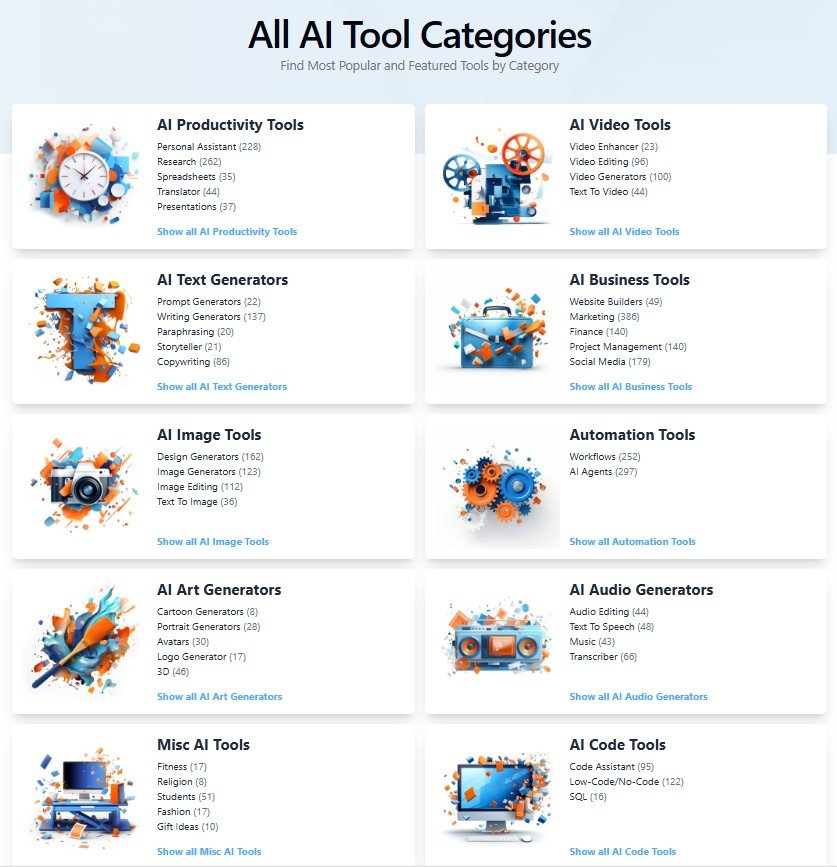
What you can find on the platform
Tools are organized in practical categories that reflect real-world use cases:
- Productivity and automation
- Image creation and design
- Video and advanced editing
- Voice AI and speech synthesis
- Coding and development
- SEO and marketing
- Data analysis and business intelligence
- Learning & education
- Customer support and chatbot solutions
Each section includes dozens of tools, from the most popular to the emerging ones.
The platform’s key strengths
One of the reasons this platform has become so valuable is its ability to stay constantly up to date: new tools are added every single day, making it a reliably current resource. The overall navigation is fast and intuitive, designed to help you find exactly what you need within seconds and without unnecessary friction.
Descriptions are short but clear, giving you just enough information to immediately understand what each tool does without overwhelming you. Another major strength is its focus on emerging solutions: many innovative tools appear here before they gain mainstream attention, giving early visitors a real competitive edge.
For professionals and businesses, it’s an especially powerful resource. It makes it easier to evaluate which technologies are worth integrating into workflows and supports a more strategic approach to adopting AI across different operations.
Limitations (for a balanced view)
Of course, no resource is perfect:
- It lists tools but does not evaluate quality.
- Some descriptions are very brief.
- The sheer number of options can overwhelm beginners.
- It may not always be 100% exhaustive, given how fast the AI space evolves.
Still, for what it aims to do — guide, not judge — it performs exceptionally well.
Conclusion
In a world where AI evolves at lightning speed, this platform is more than a catalog:
it is a compass for orientation, a radar for spotting innovations, and a travel companion for anyone who wants to use AI strategically.
It doesn’t replace human judgment.
But it accelerates discovery, comparison, and learning.
And in 2025, that’s already half the battle.