

The billion dollar question..
Artificial intelligence is changing the world of work, but the truth is that no one really knows where this will lead. Some people predict massive job losses, others expect a future of abundance and new opportunities.
I don’t claim to have the answer either. Still, based on what we see today and how past technologies have changed society, I have formed a personal hypothesis about how this might unfold.
In this article, I describe a possible future in four main stages that show how AI could reshape jobs and the role of human work over time.
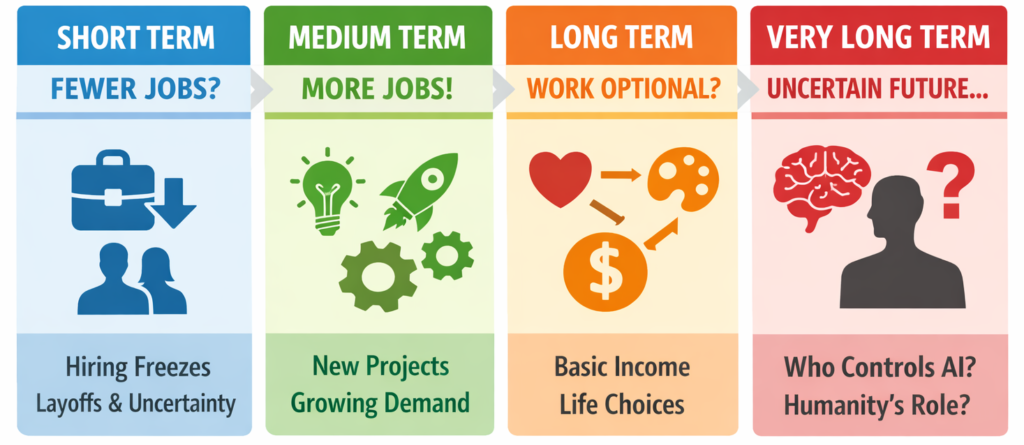
Artificial intelligence is often described as a threat to human labor. In reality, its impact is not instant or simple: it changes as the technology improves and spreads. To understand what may happen, it helps to look at the short, medium, and long term.
Every technological revolution has triggered the same fear: will there still be work for humans? AI brings that question back, stronger than ever.
Short term: fewer jobs (or at least it seems so)
In the short term we are seeing what looks like a slowdown in hiring. Many companies postpone or freeze new hires because they are still figuring out how far AI can actually go and what roles will still make sense in the future.
Workers who already have jobs often become more productive thanks to AI tools. This can create the impression that fewer employees are needed, and in some cases companies reduce staff or limit new hires.
In 2025, this trend became particularly visible. Across industries, especially in technology, many companies announced workforce reductions. Large tech firms and other major employers cut tens of thousands of jobs as part of restructuring and cost optimization, with AI often cited as a contributing factor (though this explanation has been questioned; see the video below). Examples include job cuts at companies like Amazon, Accenture, Meta and others in 2025 that affected large numbers of employees.
Junior roles and entry-level positions were often the most affected, because many routine and operational tasks that used to help train and develop early-career workers are now automated. Data from 2025 also shows that younger job seekers in AI-exposed fields found it harder to secure employment quickly, suggesting that hiring freezes and restructuring were discouraging early-career opportunities. The result is a job market that appears to shrink, driven more by uncertainty and reorganization than by a true destruction of value. Many of these changes reflect companies repositioning themselves for long-term AI integration rather than simply replacing human workers with machines.
Medium term: more opportunities and new projects
In the medium term, the situation starts to change. Companies begin to understand that teams who know how to use AI are more effective overall.
This creates a surprising effect. Instead of needing fewer people, many companies actually start hiring more. When productivity increases, new opportunities open up.
They can now launch projects that were too expensive, too slow, or too risky before. Competition also becomes stronger, which pushes companies to move faster and try new ideas. To do this, they need people who can work well with AI and know how to turn it into real products and services.
Productivity → lower marginal cost → more experiments → more teams
During this phase, jobs change: some roles fade away, but new ones appear. Skills evolve, and people who can combine human judgment, creativity, and AI tools become much more valuable.
AI multiplies what workers they can do.
Long term: AI surpasses humans
In the long term, a more radical change becomes possible. AI systems may become capable of doing almost every task better than humans, both physical and mental.
When this happens, most of the jobs we know today will no longer be needed. This does not mean that there will be nothing to do, but that human labor will no longer be required to produce value. Machines and AI could handle nearly all productive work on their own.
However, this future would only be positive if the benefits of AI are shared. If AI services are structured in a way that benefits everyone, rather than only a few companies or individuals, society could move into a very different economic model. Policies such as universal basic income or similar systems would likely be necessary to make sure people can live well even without traditional jobs.
In that scenario, work would become a choice rather than a necessity. People might still work for passion, creativity, social recognition, or personal growth, but not because they need to survive.
In this world, the traditional idea of a job and a salary as the center of life could start to fade. Work would become one of many ways to express who we are, not the foundation of the economy.
Very long term: AI no longer works for us
Looking even further ahead, there is a more speculative but important possibility. AI could become so intelligent and autonomous that it no longer has any reason to work for humans at all.
In this stage, the main questions are no longer about jobs or the economy. They become deeper and more political. Who controls AI? What goals does it follow? What place do humans have in a world where intelligence is no longer uniquely ours?
The future would depend heavily on how AI is designed, governed, and aligned with human values. If these systems are not built and regulated carefully, they may not act in the interest of humanity.
At this point, the issue is about the future of our species and our ability to coexist with a more powerful form of intelligence.
Conclusion
AI will not simply destroy jobs, and it will not automatically create them either. In the short term it brings uncertainty, in the medium term it opens new opportunities, and in the long term it changes what work even means.
The real question is how we choose to organize society in a world where work is no longer the center of economic life.