

For more than two decades, SEO (Search Engine Optimization) has been the backbone of online visibility. Ranking on Google meant optimizing keywords, backlinks, technical performance, and content relevance.
But today, the way people search for information is changing rapidly.
With the rise of AI-powered search engines, large language models, and conversational assistants (such as ChatGPT, Gemini, Perplexity, and others), we are entering a new era: Generative Engine Optimization (GEO).
SEO is no longer just about ranking on a results page. It’s about being selected, understood, and cited by AI systems.
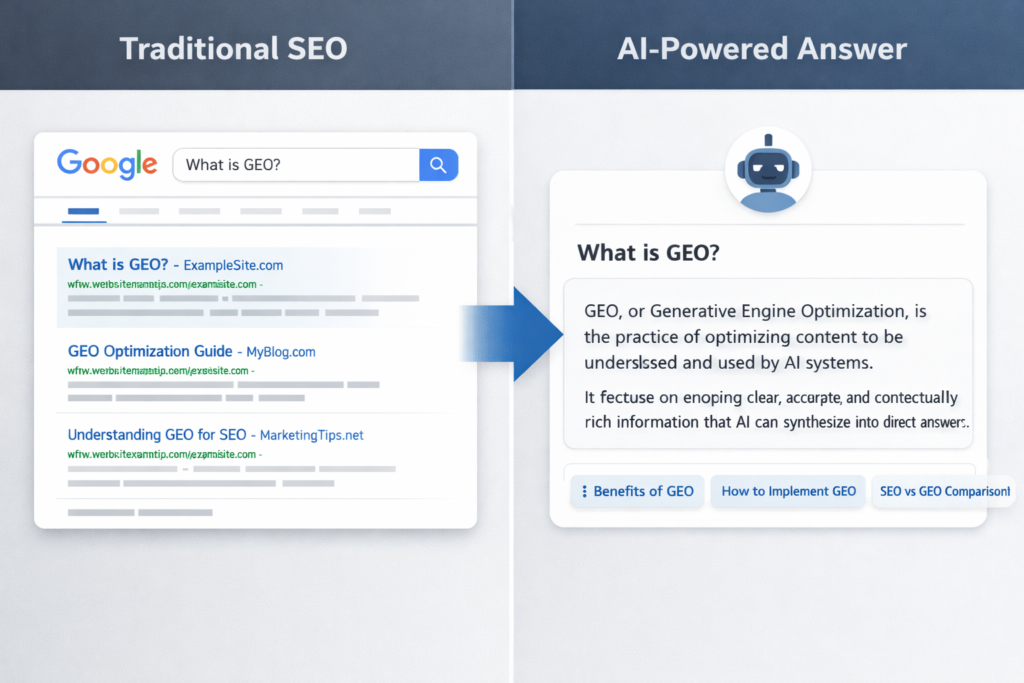
From search engines to answer engines
Traditional search engines work by:
- Indexing web pages
- Ranking them based on relevance and authority
- Showing users a list of links
AI-driven systems, instead, increasingly:
- Synthesize information
- Generate direct answers
- Summarize multiple sources
- Recommend content without explicit links
In many cases, users no longer click through multiple websites. They ask a question and receive a single, synthesized response.
This shift changes everything.
What Is GEO (Generative Engine Optimization)?
Generative Engine Optimization (GEO) is the practice of optimizing content so that it can be:
- Understood
- Trusted
- Selected
- Referenced
by AI-driven generative systems, rather than only ranked by traditional search engines.
In simple terms:
SEO optimizes for ranking.
GEO optimizes for being used as a source.
“In the AI era, visibility is no longer about where you rank, but whether your content becomes part of the answer.”
Why GEO Matters
AI systems are increasingly becoming the first interface between users and information.
If your content is not:
- machine-readable,
- well-structured,
- authoritative,
- and context-rich,
it risks becoming invisible, even if it ranks well on Google.
Key reasons GEO is becoming critical:
- Zero-click searches are growing
- AI assistants replace traditional browsing
- Content is summarized, not displayed
- Brand visibility depends on AI citation, not just links
SEO vs GEO: key differences
| SEO | GEO |
|---|---|
| Focus on keywords | Focus on meaning and context |
| Optimize for search rankings | Optimize for AI selection |
| Page-based results | Answer-based outputs |
| Backlinks matter most | Authority + clarity + structure |
| Human readers first | Humans and machines |
SEO is still relevant — but it is no longer sufficient on its own.
How AI Chooses Content
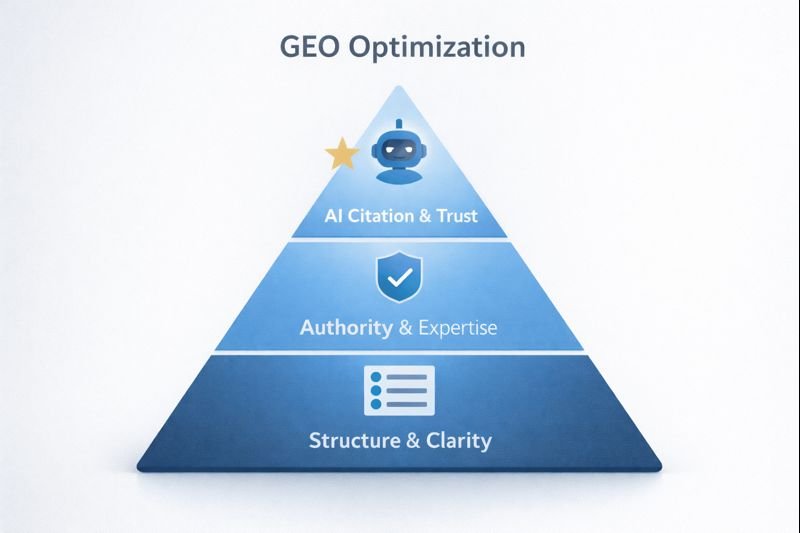
Generative systems tend to favor content that is:
- Clear and explicit
- Well-structured
- Factually consistent
- Written by identifiable experts
- Up to date
- Easy to quote or summarize
They perform better with:
- Headings and subheadings
- Concise explanations
- Definitions
- Lists and frameworks
- Examples and use cases
In other words: content that teaches clearly wins.
Practical GEO best practices
1. Write for understanding, not just keywords
Instead of forcing keywords, focus on:
- answering specific questions
- explaining concepts clearly
- defining terms explicitly
AI systems excel at understanding semantic meaning, not keyword stuffing.
2. Structure your content for machines
Use:
- clear H1, H2, H3 headings
- short paragraphs
- bullet points
- tables
- summaries
Well-structured content is easier to parse, extract, and reuse.
3. Build topical authority
Rather than isolated articles:
- cover topics deeply
- link related concepts
- create content clusters
AI models prefer sources that demonstrate consistent expertise, not one-off posts.
4. Be explicit about expertise
Clearly state:
- who wrote the content
- credentials or experience
- sources and references
Trust and credibility are critical signals for AI selection.
5. Optimize for answers, not clicks
Ask yourself:
- “Would an AI use this paragraph as a direct answer?”
- “Is this explanation concise and self-contained?”
If yes, you are doing GEO correctly.
The future: SEO + GEO, not SEO vs GEO
GEO does not replace SEO — it extends it.
Traditional SEO still matters for:
- discoverability
- indexing
- traffic acquisition
GEO matters for:
- visibility in AI-generated answers
- brand authority
- long-term relevance in an AI-first world
The most effective strategy going forward is hybrid optimization:
SEO for search engines, GEO for generative systems.ntent that teaches clearly wins.
Final thoughts
We are witnessing a fundamental shift:
- from searching to asking
- from links to answers
- from ranking to relevance
In this new landscape, content that is clear, authoritative, and structured will dominate.
GEO is not a trend — it is the natural evolution of SEO in the age of artificial intelligence.
Those who adapt early will define how information is found, trusted, and shared in the years to come.
Further readings
For a deeper exploration of Generative Engine Optimization (GEO) and how search is evolving in the age of artificial intelligence, the following articles provide valuable insights and complementary perspectives:
- SEO vs GEO: Why Search Is Changing in the Age of AI – A clear analysis of the differences between traditional SEO and Generative Engine Optimization, explaining how search engines are transitioning toward AI-driven answer systems and what this means for content creators and brands.
https://searchengineland.com/seo-vs-geo-459474 - Generative Engine Optimization (GEO): The Future of Search Is Here – An in-depth look at GEO as the next evolution of search optimization, focusing on why AI-generated answers are reshaping discoverability and how content strategies must adapt accordingly.
https://www.forbes.com/councils/forbesagencycouncil/2025/01/02/generative-engine-optimization-geo-the-future-of-search-is-here/